MIG vs TIG Welding: Which Process Suits Your Sheet Metal Part?
The difference between MIG and TIG comes down to one line: MIG is built to put metal down fast; TIG is built to join metal precisely. Speed, control, appearance and cost all follow from that single difference.
Both are arc welding processes, and both will hold a sheet metal part together. The difference between MIG and TIG welding shows up after the weld cools — in how much the part has moved, how much grinding the joint needs, how long it took, and what it cost per metre. Choosing the wrong one rarely ruins a part outright. It quietly adds a straightening step, an hour of finishing, or a unit price that never comes down.
You do not need to be a welder to make this decision. What you need to know is which process suits the part, what each one costs you in time and finishing, and how to ask for it on a drawing. This guide covers exactly that, and ends with a table you can use on a real part.
The short answer
- Use MIG for steel from about 1.5 mm upward, long straight joints, frames and brackets, and any weld that will be painted, powder coated or hidden inside the assembly.
- Use TIG for material under roughly 3 mm, welds the customer will see, stainless steel and aluminium, and parts that cannot be allowed to warp or burn through.
- Most real assemblies use both — MIG for the structural runs, TIG for the visible corner or the thin panel.
How each process works, in plain terms
MIG welding (also called GMAW)
MIG works like a hot glue gun. A wire is fed continuously through the torch, melts in the arc, and fills the joint as the operator moves along. The wire is both the filler and the electrode, so nobody has to add metal by hand. Set the speed once and the process keeps feeding itself.
That is why MIG is fast, and why it tolerates small gaps and awkward joints. In sheet metal welding it is the default for mild steel frames, brackets, base plates and enclosures from about 1.5 mm upward.
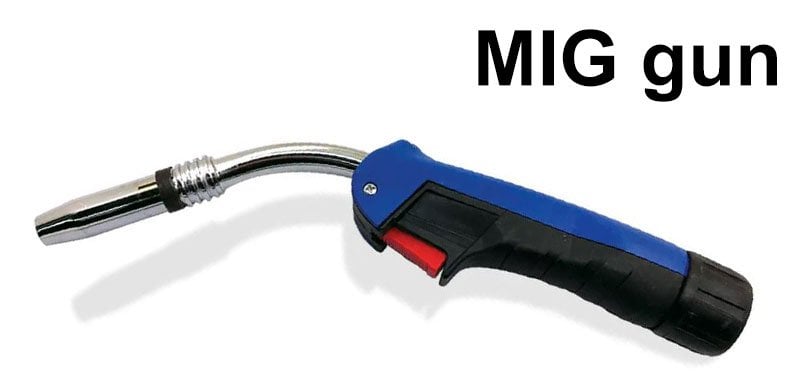
A MIG gun. The wire is fed continuously from the machine through the gun and into the arc, where it acts as both the filler metal and the electrode.
TIG welding (also called GTAW)
TIG works more like a fine pen. A tungsten electrode creates the arc but does not melt into the part. The filler wire is added separately, by hand, and only where it is needed. Heat and filler are controlled independently, which is why TIG is precise — and why it is slow.
TIG is the process for thin material, visible stainless steel, aluminium, and any joint where the weld itself is the finished surface the customer will look at.
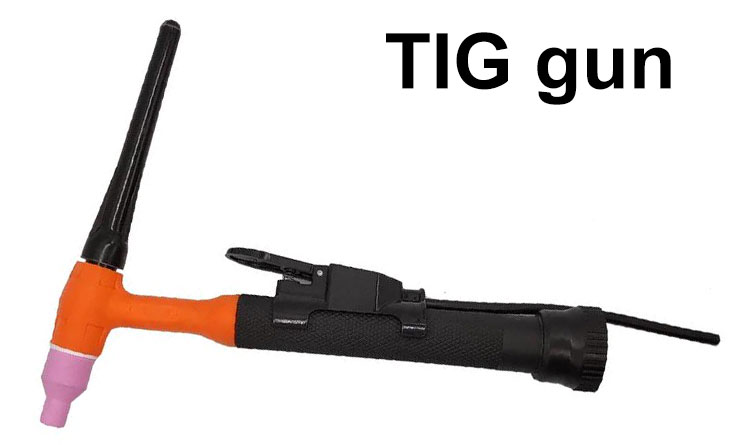
A TIG gun. There is no wire feed inside it: a tungsten electrode carries the arc and does not melt into the joint, while the filler rod is added separately by hand and only where it is needed.
MIG vs TIG Welding: Side-by-Side Comparison
| What you are comparing | MIG (GMAW) | TIG (GTAW) |
|---|---|---|
| How metal is added | A wire is fed continuously by the machine — the wire is the electrode | The tungsten electrode does not melt; filler wire is added by hand |
| How it is protected | Shielding gas for carbon steel is an argon–CO2 mix; pure argon for aluminium | Almost always pure argon |
| Comfortable thickness | 1.5–10 mm; above 10 mm needs several passes | 0.5–6 mm; uneconomical on heavy sections |
| Metal deposited per hour | 2–3 kg/h by hand; 5–6 kg/h on automatic cells | 0.3–1 kg/h by hand; around 3 kg/h on automatic setups |
| Speed on a long joint | Several times faster than TIG | Slow — the main reason TIG costs more per metre |
| Effect on thin panels | More total heat, so thin sheet buckles more easily | Heat can be tapered and held steady, so thin panels stay flatter |
| What the weld looks like | Neat but visible ripples, some spatter; normally ground or painted | Clean, smooth, almost no spatter; often left as it is |
| Skill needed | Moderate — easier to learn, more forgiving of poor fit-up | High — a consistent cosmetic result depends on the operator |
| Where the cost goes | Low labour per metre, but more grinding afterwards | High labour per metre, but little or no finishing afterwards |
| Typical sheet metal parts | Frames, brackets, base plates, cabinets, structural assemblies | Stainless enclosures, panels, covers, food and medical equipment, visible corner joints |
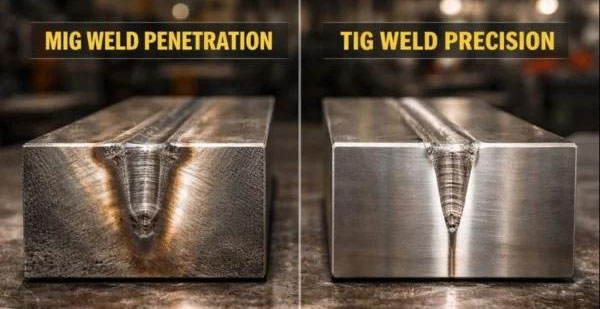
MIG and TIG welding compared on thick sheet: MIG on the left, TIG on the right. On heavy plate, MIG fills the joint in a fraction of the passes. TIG can produce the same joint, but each pass adds only a thin layer of metal, so the welding time and the labour cost climb quickly.
What the numbers mean for your part
Speed is the biggest cost driver
MIG lays down roughly five to ten times more weld metal per hour than TIG. On a long structural joint, that gap is what you are paying for in the quotation. On a short decorative weld, it barely matters.
But speed is only half of the story. A fast MIG weld that then needs twenty minutes of grinding is not cheaper than a slower TIG weld that needs none. The real comparison is cost per finished part, not cost per metre of weld.
Thickness decides most of the argument
Below about 1.5 mm, the risk is burning a hole through the sheet. TIG controls that risk far better, and on very thin material it is usually the safer quotation. Between 1.5 and 3 mm, both processes are viable and the choice depends on finish. Above 3 mm, MIG becomes clearly cheaper, and above 10 mm TIG is only used for the first pass or for repair.
Distortion is not automatic with either process
Warping comes from heat being put in unevenly, not from the process name. MIG puts in more heat faster; TIG can put in just as much if the operator lingers in one spot. What actually controls distortion is the tacking sequence, the clamping and the direction of welding — which is a fabricator's responsibility, and a fair question to ask about when you are comparing suppliers.
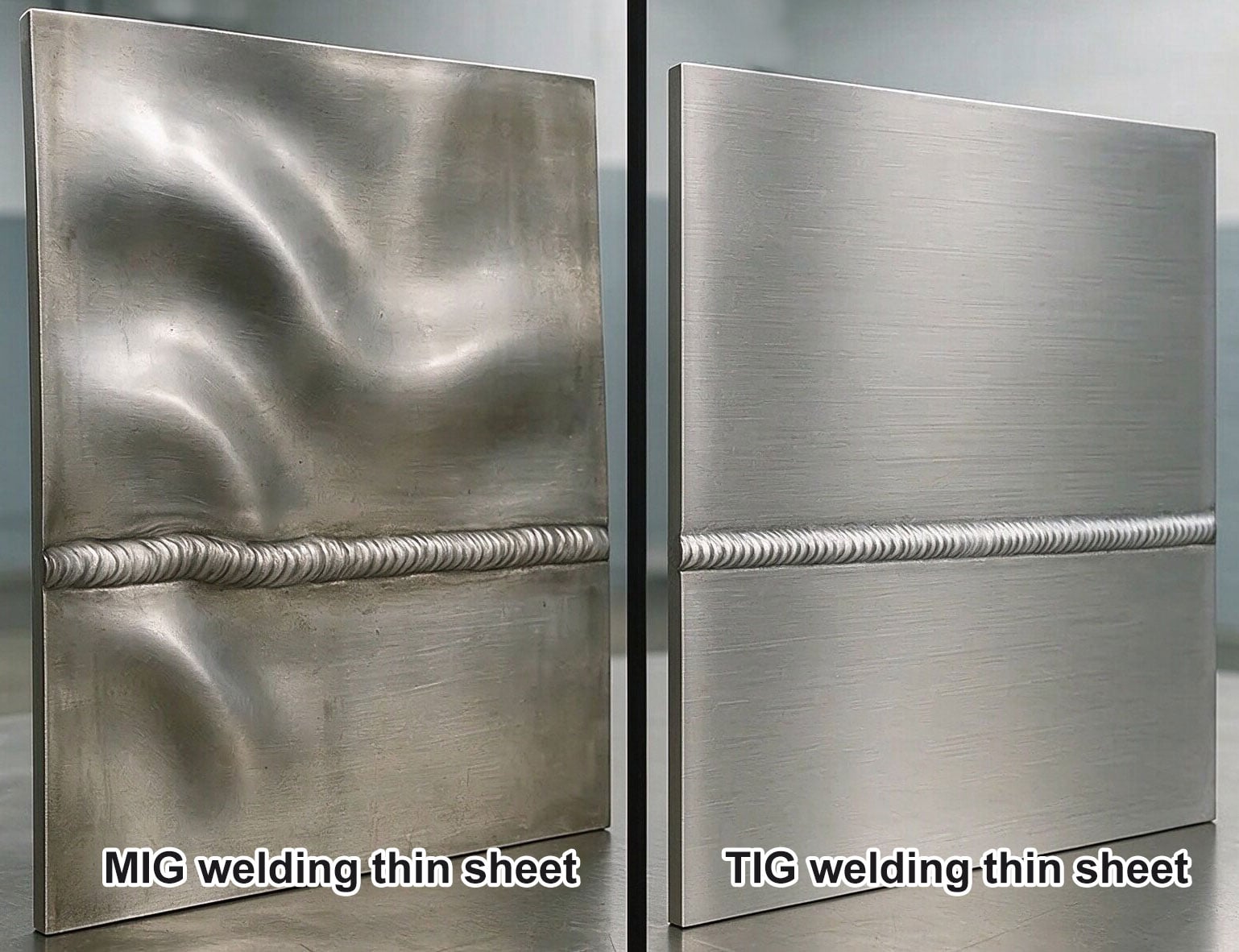
MIG and TIG welding compared on thin sheet: MIG on the left, TIG on the right. The MIG weld pulls the panel out of shape; the TIG weld keeps it flat. This is the difference heat input makes on light gauge. MIG can be made to work on thin sheet, but it needs lower current, a different transfer mode and tighter clamping — which is exactly what the quotation has to pay for.
Typical settings by thickness
If you are specifying the part rather than welding it, you can skip this table — your fabricator sets these values. It is here so that an engineer can check a quotation or a welding procedure against a sensible starting point.
| Process | Sheet thickness | Current | Electrode / wire | Shielding gas flow |
|---|---|---|---|---|
| MIG | 0.8–1.5 mm | 60–120 A | 0.8 mm wire | 12–15 L/min |
| 1.5–3 mm | 100–160 A | 0.8–1.0 mm wire | 15–18 L/min | |
| 3–6 mm | 160–250 A | 1.0–1.2 mm wire | 18–22 L/min | |
| 6–10 mm | 250–320 A | 1.2 mm wire | 20–25 L/min | |
| TIG | 0.5–1 mm | 20–60 A | 1.6 mm tungsten, 1.0–1.6 mm rod | 6–8 L/min |
| 1–3 mm | 60–120 A | 1.6–2.4 mm tungsten, 1.6–2.4 mm rod | 8–12 L/min | |
| 3–6 mm | 120–200 A | 2.4–3.2 mm tungsten, 2.4–3.2 mm rod | 10–15 L/min |
Sheet Metal Welding by Material
The right process changes with the metal. The notes below cover the materials most often specified in sheet metal fabrication, and where the choice between TIG and MIG welding stops being a free one.
In most sheet metal work the TIG vs MIG welding decision is settled by the material and the required finish long before cost is considered.
Carbon steel
Above about 1.5 mm, MIG is the standard choice: faster, cheaper, and more than strong enough for structural joints. TIG is used on carbon steel mainly when the weld is visible and the part is thin — a 1.2 mm cover panel on a machine frame, for example.
Stainless steel
Both work. The choice is almost always about appearance, not strength. TIG leaves a clean bead with no spatter and little discolouration, which is why it dominates visible stainless work — enclosures, kitchen equipment, architectural panels. MIG on stainless is faster and perfectly acceptable where the weld will be ground, pickled or hidden, but it needs cleaning afterwards.
Aluminium
Below about 2 mm, TIG gives better control and less risk of burning through. Between 2 and 3 mm it depends on whether speed or appearance matters more. Above 3 mm, MIG is usually the more economical choice, and above about 10 mm TIG is limited to the root pass and repairs. Aluminium also pulls heat away from the weld much faster than steel, so both processes need more current than the same thickness of steel.
Galvanised and coated steel
The zinc coating burns off in the arc and causes porosity if it gets into the weld. MIG is generally preferred because it is faster and pushes through the coating more easily, but the weld area should still be cleaned back to bare steel and re-protected afterwards. TIG on galvanised steel is slow and prone to contamination, and rarely the right choice for production.
Copper and brass
Both metals conduct heat away very quickly, so the part usually needs preheating. TIG is common for copper because it gives a stable arc on a preheated part; MIG can be used on thicker sections.
Decision Matrix
Use this table to narrow the choice from a drawing. Where two rows disagree, appearance and thickness usually decide; cost only decides when the part is high volume.
| If the part is… | Use | Because |
|---|---|---|
| Under 1.5 mm, any material | TIG | Burn-through and distortion are the main risks; MIG needs special settings to compete |
| 1.5–6 mm carbon steel, weld hidden or painted | MIG | Fastest and cheapest per metre; appearance does not justify TIG |
| Visible stainless or aluminium weld, left as-welded | TIG | No spatter, little discolouration, no grinding step |
| Long straight seams over 500 mm | MIG | The machine feeds itself at a constant speed |
| Short, curved or changeable joints | TIG | The operator can adjust heat mid-run without stopping |
| Structural frame or load-bearing bracket | MIG | Enough penetration at the lowest cost per joint, easy to automate |
| Thin panel with a cosmetic corner | TIG | Heat can be reduced at the end of the run to avoid a burnt corner |
| Batch production of identical parts | MIG, preferably automated | Repeatability and speed dominate the cost model |
| Mixed assembly — frame plus visible panels | Both | MIG for structure, TIG for the faces the customer will see |
Cost: why TIG is sometimes cheaper per part
Comparing MIG welding vs TIG welding on welding time alone, MIG wins decisively. But welding time is not the whole cost. TIG often produces a bead that needs no grinding and no re-finishing. MIG often produces one that does.
On a stainless enclosure with 1.2 mm walls, a MIG weld that takes two minutes can easily need six to eight minutes of grinding and blending. A TIG weld that takes six minutes may need none. Suddenly the slower process is the cheaper one.
The break-even point usually falls in one of three places:
- Hidden structural joints: MIG welding wins on almost every count — fastest, cheapest, no finishing required.
- Visible joints above 3 mm: the comparison is close. MIG plus grinding is often still cheaper, provided the grinding is done consistently.
- Visible joints under 3 mm in stainless or aluminium: TIG usually wins. MIG needs special settings, careful clamping and a finishing step, and the risk of distortion remains.
There is also the cost of rework. Thin-sheet MIG done without the right settings tends to burn through, which means cutting out the weld, re-fitting the part and starting again. A rejected part costs far more than the extra welding minutes.
What can go wrong, and who is responsible
Burn-through
Almost always a thin-sheet problem, and almost always MIG. The fix is lower current, a different transfer mode, or switching to TIG. On material below 1 mm, a well-fitted joint welded with TIG is the more reliable route.
Distortion and warping
Caused by uneven heat, not by the process alone. Both processes need a tacking sequence, adequate clamping and a weld direction that balances heat. This is the fabricator's job — if a supplier blames the process for a warped part, ask what clamping and sequence they used.
Spatter
A MIG characteristic. It comes off with grinding or blasting, and every minute of it is a cost the drawing did not ask for. If the part is visible, specify whether the weld must be spatter-free as welded.
Porosity
Caused by contamination — oil, paint, zinc coating, moisture, or shielding gas disturbed by draughts. Galvanised steel and aluminium are the usual offenders. The joint must be cleaned back to bare metal before welding; this is a preparation issue, not a process issue.
Frequently asked questions
Not inherently. Strength depends on how deeply the weld penetrates and fuses, not on the process name. A properly made MIG weld is as strong as a properly made TIG weld. TIG is often assumed to be stronger because it is used on thin, high-value parts that get inspected closely — but a MIG joint with full penetration on the same part would meet the same strength requirement.
Yes. MIG is routinely used on stainless steel with a matching filler wire and an argon-based shielding gas. The limitation is appearance, not strength: MIG leaves more spatter and a wider discoloured zone, so it is usually specified where the weld will be ground, pickled or hidden. For visible stainless left as-welded, TIG is the better choice.
Below about 1.5 mm, TIG is generally safer. The heat can be controlled precisely and tapered at the end of a run, and there is no wire feed pushing through the sheet. MIG can be used below 1.5 mm with pulsed or short-circuit settings, and many production shops do so successfully, but it needs tighter fit-up and better clamping.
Because the filler is added by hand, one rod at a time, while the operator also controls the arc. There is no continuous wire feed. A manual TIG welder deposits roughly 0.3–1 kg of filler per hour, against 2–6 kg/h for MIG. TIG also runs at lower current on thin material, which slows it further.
Yes, and it is the preferred process for thin aluminium. Aluminium needs alternating current to break up the oxide layer on the surface, and pure argon or an argon–helium mix for shielding. Above roughly 3 mm, MIG becomes more economical, and above about 10 mm TIG is normally limited to the root pass and repair work.
For hidden structural joints, MIG is almost always cheaper — it deposits metal several times faster and needs no cosmetic finishing. For visible thin-gauge stainless or aluminium, TIG can be cheaper per finished part, because it removes a grinding and blending step that MIG would need. The break-even depends on how much of the MIG weld has to be ground afterwards.
No. If the joint is hidden, structural, or will be painted or powder coated, the bead is usually left as-welded. Grinding is specified when the weld is visible, when a flush surface is needed, or when the part is stainless and the heat tint has to come off. Deciding this at the drawing stage avoids paying for finishing the part does not need.
It is usually better to specify the requirement than the process: material, thickness, joint type, whether the weld is visible, and the finish required. A fabricator can then choose MIG, TIG or a combination to meet it at the lowest cost. If the process is fixed by a customer standard or a qualified welding procedure, state it — otherwise describe the result you need and leave the method to the shop.
Usually because the suppliers are quoting different processes, different amounts of finishing, or different levels of inspection — not because one is cheaper. A quote that assumes MIG and no grinding will always look lower than one that assumes TIG and a blended finish. Ask each supplier which process they priced and what finishing is included, and the numbers start to make sense.
Yes, and on many parts it is the right answer. A typical mixed assembly uses MIG for the internal frame and structural joints, then TIG for the visible faces and thin panels. This is common in stainless enclosures and machine covers, where most of the welding is hidden but the customer will inspect the outside.
Summary
MIG and TIG welding are not competing answers to the same question. MIG welding is a production tool: fast, economical, well suited to structural joints and thicker sheet. TIG welding is a precision tool: slower, cleaner, and the right answer wherever the weld is the visible surface or the material is thin enough to burn through. The most cost-effective sheet metal assemblies usually combine both — and the choice of process is best made from the drawing, before the first part is cut.
If you are sourcing welded sheet metal parts and want the process selected against your drawing rather than a shop's default, our welding services page sets out the processes, thickness ranges and inspection methods used.