Powder Coating for Welded Sheet Metal Parts
A welded part has more places to rust than any other sheet metal component. Weld seams, cut edges, the heat-affected zone around each bead and every spatter bump are the first places moisture reaches — and the hardest places to clean.
That is why powder coating a welded assembly is won or lost at the pre-treatment stage, not at the spray gun. If cutting oil, welding oxide or spatter is left on the surface, the powder bonds to the contaminant instead of the steel.
Most coating failures on a welded part are not visible on the day of delivery. They start at a seam or an edge months later, when the part is already in service — and a claim or a rework costs far more than the preparation would have.
Where Welded Parts Rust First
The Weld Seam
Porous weld metal and small crevices hold moisture that the coating cannot seal out.
Cut Edges
Coating thins where a surface ends. Edges are where corrosion almost always starts.
Heat-Affected Zone
The metal beside each bead changes structure and oxidises in the weld heat. Pretreatment does not work the same way there as on the parent sheet.
Spatter
Each droplet is a raised point that takes too much powder on top and too little around its base.
Why Cleaning Alone Is Not Enough
Degreasing removes oil. It does not remove weld scale or heat tint, and those are what the coating is actually sitting on. Oxide scale has roughly one-tenth of the adhesion of clean steel — powder sprayed over it passes a visual check and fails in service.
Mechanical work comes first, chemical work second. Grinding or blasting the weld seams before degreasing stops the cleaning stage from being clogged with scale and spatter, and gives the pretreatment something sound to bond to.
Our Sequence for Welded Parts
"Pretreatment" is not one step. It is a line of baths, and which ones a part goes through depends on the material and how much rust or scale it carries.
1. Surface preparation
Weld beads dressed and spatter removed, then the surface taken back to bare metal — by grinding or by blasting, whichever suits the part. Spatter is kept off with physical shielding where possible, and silicone-based anti-spatter is avoided, because trace residue leaves craters in the powder.
2. Degrease
Alkaline bath removes cutting oil and welding residue, followed by a water rinse.
3. Pickle
Acid bath lifts rust and scale from the surface and the seam. Neutralised and rinsed afterwards so no acid stays behind.
4. Conversion coat
Surface conditioning and phosphating — or a silane system — build the layer that carries the corrosion protection.
5. Dry
A dry-off oven removes moisture before any powder goes on.
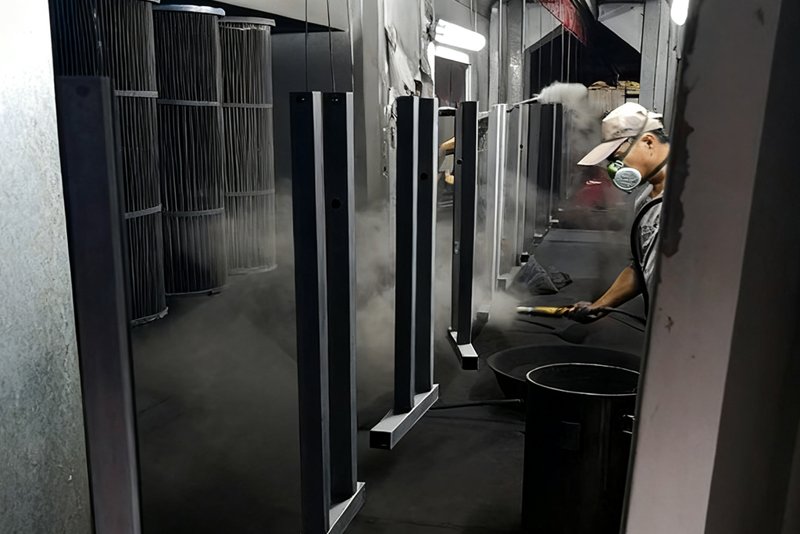
6. Powder and cure
Electrostatic spray, then held at the specified temperature for the full time.
It Depends on the Material
- Carbon steel. The weld scale has to go, so the seam is taken back to bare metal by grinding or blasting, then pickled before pretreatment.
- Stainless steel. The heat tint beside a weld is a chromium-depleted zone. It is pickled before coating to restore the passive layer.
- Aluminium. The natural oxide is thicker around the weld, so it is etched before pretreatment rather than coated over.
- Galvanised sheet. Welding burns the zinc off the seam, leaving bare steel. That area is prepared as carbon steel would be.
Three Things You Can Do Before Ordering
- Keep weld seams continuous on the drawing. A narrow gap between two beads cannot be reached by the spray gun.
- Mark the faces that must stay uncoated — mating surfaces and threaded holes.
- Tell us where the parts will be used. Outdoor, coastal or indoor changes the powder and film build we recommend.
How We Verify It
Neutral salt spray (NSS) and copper-accelerated salt spray (CASS) rigs run in our own lab, so a coating specification is checked against the actual part rather than a powder supplier's data sheet. If you are coating a welded assembly and want to know how it will hold up, send a sample part — we will coat it, put it through salt spray and give you a number before you commit to a batch.
Because the same factory cuts, bends, welds and coats, a welded frame is coated in the same working week it was welded. Nothing is shipped to a separate coating shop and back, and the team that inspects the weld is the team that inspects the finish.
Defects and Questions
Usually moisture or oil trapped in the weld or under the edge of the bead. It is a preparation problem, not a powder problem.
Contamination — silicone anti-spatter, compressor oil or a dirty booth. Silicone anti-spatter is kept off the line for this reason, and booth air is filtered and checked.
Coating thins where a surface ends. Edges are rounded and checked before coating, and they are the first place we look on a salt spray sample.
The coating has to come off the weld area first, and the repair is never as good as the original coat. Weld first, coat last.
15–20 years with proper pretreatment and an exterior-grade powder, provided the weld zone is prepared like the rest of the part.
A 2D drawing plus a 3D model where available, the quantity and the colour. Marking the no-coat faces on the drawing saves a round of questions.
Welded Parts That Need to Last?
Send your drawing and let us coat a sample. You get a salt spray figure before you commit to a batch.
Get a Free Quote